Building Confidence Through Art: Why Every Child Needs Creative Expression
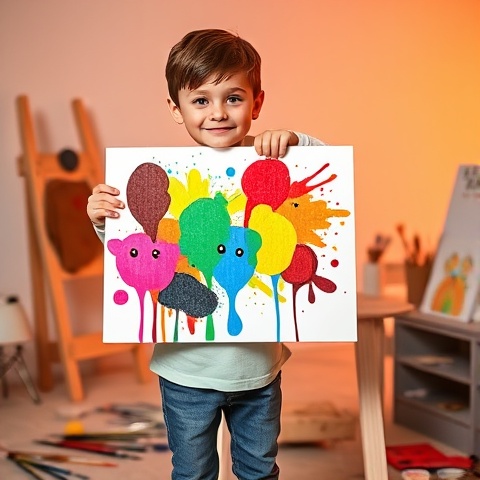
There's something magical that happens when a child picks up a crayon, brush, or even just starts doodling with their finger in the sand. Their posture changes, their breathing deepens, and for a moment, the world narrows to just them and their creative expression. As parents, we often focus on the end result—the picture that goes on the refrigerator—but the real magic happens during the process itself.
Art isn't just about creating something beautiful (though that's wonderful too). It's about giving children a safe space to experiment, fail, try again, and ultimately discover that they have the power to create something uniquely their own. In a world that often tells children what to think, how to behave, and what's "correct," art offers them a space where there are no wrong answers—only exploration and self-discovery.
The Confidence Connection: What Research Shows Us
Studies consistently show that children who engage in regular creative activities demonstrate higher levels of self-esteem, better emotional regulation, and increased willingness to take on new challenges. When children create art, they're not just making pictures—they're building neural pathways that support confidence, resilience, and creative problem-solving throughout their lives.
Dr. Cathy Malchiodi, a leading art therapy researcher, notes that "the creative process helps children develop a sense of mastery and control over their environment, which directly translates to increased confidence in other areas of their lives."
How Art Builds Confidence: The Science Behind the Magic
1. Safe Space for Risk-Taking
Art provides a consequence-free environment where children can experiment with ideas, colors, and techniques without fear of "getting it wrong." This safe space for risk-taking is crucial for developing confidence. When children learn that it's okay to try new things and that "mistakes" can lead to beautiful discoveries, they develop a growth mindset that serves them well beyond the art table.
Think about it: when a child mixes yellow and blue and discovers green, they're not just learning about color theory—they're learning that exploration leads to discovery, that they have the power to create something new, and that experimentation is valuable in itself.
2. Immediate Sense of Accomplishment
Unlike many other activities where success might be measured by external standards or take a long time to achieve, art offers immediate gratification. Every mark on the paper is an accomplishment. Every color choice is a decision they made independently. This immediate feedback loop helps children build confidence incrementally, one brushstroke at a time.
Using tools like our AI Coloring Page Generator, children can see their ideas come to life almost instantly. When they describe "a friendly dragon wearing a hat" and see it appear as a coloring page, they experience the powerful feeling of their imagination made real.
3. Personal Expression and Voice
Art gives children a way to express thoughts and feelings they might not have words for yet. Through color choices, subject matter, and artistic techniques, children develop their unique voice and style. This personal expression is incredibly validating—it tells children that their inner world matters and deserves to be shared.
When children use our Online Coloring Tools to make a sunset purple instead of orange, or color a tree with rainbow leaves, they're asserting their right to see the world differently. This creative autonomy builds confidence in their own perspective and judgment.
Practical Ways to Nurture Confidence Through Art
Focus on Process, Not Product
Instead of saying "What a beautiful picture!" try "Tell me about the colors you chose" or "I noticed you spent a lot of time on this part—what were you thinking about?" This shifts the focus from external validation to the child's own experience and decision-making process.
When children know that their creative process is valued regardless of the outcome, they feel free to experiment and take risks, which ultimately leads to both better art and stronger confidence.
Provide Variety and Choice
Confidence grows when children have agency over their creative choices. Offer different materials, techniques, and subjects. Let them choose whether they want to work on a pre-made coloring page or create something entirely original on our Digital Drawing Canvas.
Choice-making is confidence-building. Every time a child chooses red over blue, decides to add stars to their sky, or opts to draw their family instead of animals, they're exercising creative control and building trust in their own judgment.
Create Art Together
When you create art alongside your child—not directing them, but working on your own project nearby—you model that creativity is valuable at any age and skill level. This side-by-side creating often leads to natural conversations about choices, challenges, and discoveries.
Try converting a family photo using our Photo Converter and then coloring it together, each person working on different parts. This collaborative approach builds confidence while creating shared memories.
The Ripple Effect: How Art Confidence Spreads
The confidence children build through art doesn't stay contained to creative activities. When children learn to trust their creative instincts, they're more likely to speak up in class, try new foods, make new friends, and tackle challenging school subjects. The "I can figure this out" attitude that art fosters becomes a life skill.
Research shows that children with strong creative confidence are more resilient in the face of setbacks, more innovative in their problem-solving approaches, and more comfortable with ambiguity and uncertainty—all crucial skills for navigating our rapidly changing world.
Moreover, art-confident children often become more empathetic and emotionally intelligent. Through creating and sharing their art, they learn to communicate feelings, understand different perspectives, and appreciate the unique viewpoints of others.
Age-Appropriate Confidence-Building Activities
Ages 3-6: Foundation Building
- • Large paper and chunky crayons for bold, confident strokes
- • Finger painting to connect with the tactile joy of creating
- • Simple coloring pages with large spaces
- • "Mistake" celebrations—turning "oops" into opportunities
- • Displaying all artwork, not just the "pretty" pieces
Ages 7-12: Skill and Confidence
- • Teaching basic techniques while encouraging personal style
- • Collaborative projects that build on each other's strengths
- • Art challenges that encourage problem-solving
- • Opportunities to teach younger children
- • Regular "art shows" to celebrate progress and growth
Every Child is an Artist: Nurturing Natural Creativity
Pablo Picasso once said, "Every child is an artist. The problem is how to remain an artist once we grow up." The confidence that children naturally bring to their creative expression is something we should protect and nurture, not judge or redirect.
By providing opportunities for authentic creative expression—whether through traditional art supplies, digital tools, or innovative combinations of both—we give children something invaluable: the knowledge that their ideas matter, their creativity has value, and they have the power to bring beauty into the world.
Remember, the goal isn't to create the next Picasso (though that would be wonderful too!). The goal is to raise confident, creative, emotionally intelligent humans who know that they have something unique to contribute to the world.