Learning Through Coloring: A Fun Gateway to ABCs, Numbers, and More
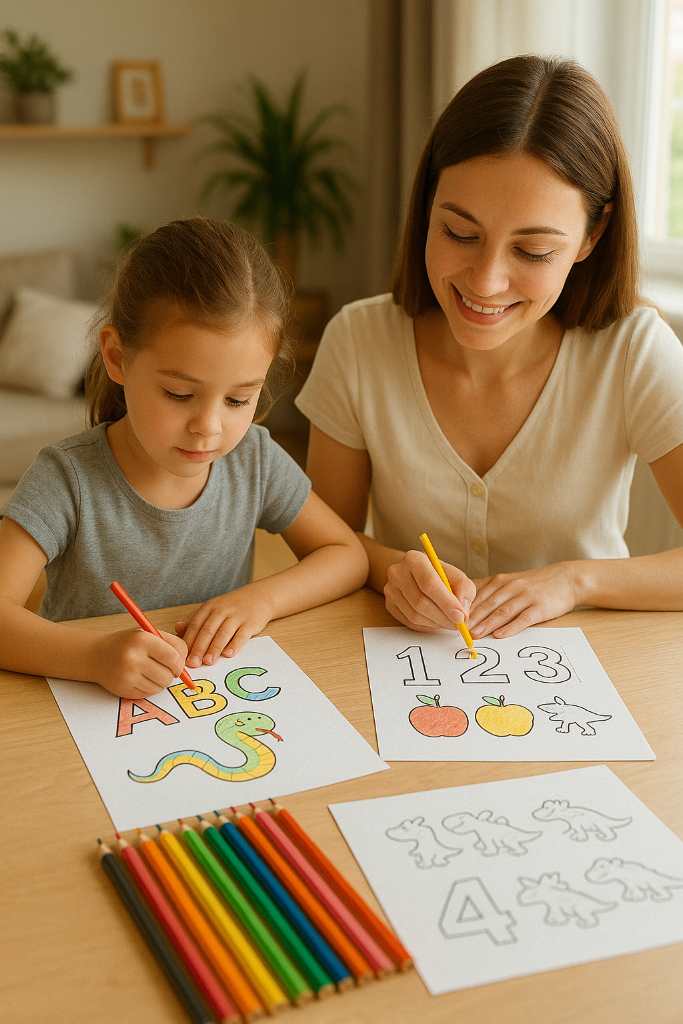
What if you could teach your child foundational skills without them even realizing they're learning? That's the secret power of educational coloring. By combining a fun, creative activity with learning concepts, you create a positive and stress-free environment where knowledge is absorbed naturally. It's play-based learning at its best!
Research shows that children learn best when they're engaged and having fun. When we combine the calming, focusing effects of coloring with academic concepts, we create an ideal learning environment. The repetitive motions of coloring help cement information in long-term memory, while the visual and tactile experience appeals to multiple learning styles.
The Science Behind Multi-Sensory Learning
When children engage multiple senses simultaneously, they create stronger neural pathways. Educational coloring activates:
- Visual processing: Recognizing letters, numbers, and shapes
- Motor skills: Fine motor control through coloring movements
- Auditory processing: When you discuss what they're coloring
- Cognitive processing: Making connections between symbols and meanings
This multi-sensory approach is particularly effective for children with different learning styles, including those with ADHD, dyslexia, and autism spectrum disorders.
Age-Appropriate Learning Through Coloring
Ages 2-3: Pre-Academic Foundation
At this age, children are developing basic cognitive skills that will support later academic learning. Focus on simple concepts and large, easy-to-color areas.
Key Learning Goals:
- Color recognition: "Let's find all the red things on this page"
- Shape awareness: "This is a circle. Can you color inside the circle?"
- Size concepts: "Here's a big elephant and a little mouse"
- Basic counting: "One, two, three balloons!"
- Following directions: "Color the sun yellow"
Recommended Activities:
- Simple shape coloring pages with clear, thick borders
- Single objects to color (one big apple, one happy sun)
- Basic color-matching activities
Ages 3-4: Pre-K Readiness
Children are ready for more structured learning activities while still maintaining the playful approach. They can handle more complex instructions and are developing pre-reading skills.
Key Learning Goals:
- Letter recognition: Starting with letters in their name
- Number recognition: Numbers 1-10
- Phonemic awareness: "B is for Ball - what sound does B make?"
- Pattern recognition: Simple ABAB patterns
- Sorting and classification: "Color all the animals blue"
Advanced Activities:
- Alphabet pages with letter formation practice
- Number pages with corresponding quantities to count
- Category pages (all farm animals, all vehicles)
Ages 4-6: Kindergarten and Beyond
Children can handle complex, multi-step learning activities and are ready for academic concepts that will prepare them for formal schooling.
Key Learning Goals:
- Reading readiness: Sight words, beginning/ending sounds
- Math concepts: Addition, subtraction, basic geometry
- Science concepts: Life cycles, weather, seasons
- Social studies: Community helpers, cultures, geography
- Critical thinking: Problem-solving through puzzles and mazes
Comprehensive Literacy Development
Reading isn't just about recognizing letters—it's a complex process involving multiple skills. Here's how to use coloring to support each component:
Phonological Awareness Activities:
- Rhyming pages: Generate pages with rhyming objects (cat, hat, bat) and discuss the similar sounds
- Alliteration pages: "Silly Sam's Snake" - pages where everything starts with the same sound
- Syllable clapping: While coloring, clap out syllables in object names
Letter Formation and Recognition:
- Alphabet hunts: Create pages where children find and color specific letters hidden in pictures
- Letter association: "A is for Apple" pages with large letters and corresponding images
- Upper and lowercase matching: Pages that show both forms of letters
Sight Word Integration:
- Word recognition pages: Simple sentences with sight words to color
- Environmental print: Pages with signs, labels, and familiar logos
- Story sequencing: Multiple pages that tell a simple story
Mathematics Through Art: Beyond Basic Counting
Number Sense Development
True mathematical understanding goes beyond memorizing numbers. It involves understanding quantity, relationships, and patterns. Coloring can support all these concepts.
One-to-One Correspondence
This fundamental math skill involves matching each object with one number. Create pages where children must color exactly the right number of objects:
- "Color 3 balloons red, leave the rest uncolored"
- "Each child needs one hat - color one hat for each child"
- "Match each dog with one bone by coloring them the same color"
Quantity Recognition
Help children understand what numbers actually represent:
- Subitizing practice: Pages with small groups (1-5) that children can recognize without counting
- More/less comparisons: "Color the group that has more flowers"
- Equal groups: "Make each basket have the same number of apples"
Pattern and Sequence Recognition
Patterns are the foundation of mathematical thinking:
- Color patterns: "Red, blue, red, blue - what comes next?"
- Shape patterns: Sequences of circles, squares, triangles
- Size patterns: Big, small, big, small progressions
- Growing patterns: 1 flower, 2 flowers, 3 flowers
DIY Math Activities You Can Create:
Custom Color-by-Number Pages:
Take any coloring page and add numbers to different sections. Create a key where numbers correspond to colors. For advanced learners, make the key into math problems (2+2=Red, 5-1=Blue).
Shape Scavenger Hunt Pages:
Generate pages with lots of different shapes hidden in the design. "Find and color all the triangles green, all the circles yellow," etc.
Measurement Activities:
Create pages with objects of different sizes. "Color the longest snake, circle the shortest pencil, color the biggest cookie."
Science and Discovery Through Coloring
Science is all about observation, classification, and understanding how things work. Coloring pages can introduce and reinforce scientific concepts in engaging ways.
Life Science Concepts:
- Life cycles: Butterfly metamorphosis, plant growth, frog development
- Animal classification: Mammals, birds, fish, reptiles, amphibians
- Habitats: Who lives where and why (ocean, forest, desert, etc.)
- Human body: Basic anatomy, healthy habits, five senses
Earth Science Concepts:
- Weather patterns: Different types of clouds, seasons, water cycle
- Solar system: Planets, sun, moon, stars
- Rocks and minerals: Different types and their properties
- Environmental science: Recycling, conservation, ecosystems
Physical Science Concepts:
- Simple machines: Levers, pulleys, wheels and axles
- States of matter: Solid, liquid, gas examples
- Light and color: Rainbow formation, shadows
- Sound: Loud/quiet, musical instruments
Creating Effective Educational Coloring Sessions
The 3-Phase Learning Model
Phase 1: Pre-Coloring (Setup and Introduction) - 5 minutes
- Preview the page: "What do you see on this page?"
- Activate prior knowledge: "What do you already know about butterflies?"
- Set learning goals: "Today we're going to learn about the letter B and things that start with B"
- Introduce key vocabulary: Define 2-3 important words
Phase 2: During Coloring (Active Learning) - 15-20 minutes
- Ask open-ended questions: "Why do you think the caterpillar needs to eat so much?"
- Make connections: "This reminds me of when we saw butterflies in the garden"
- Encourage predictions: "What do you think happens next in the story?"
- Practice skills: "Let's count the dots on the butterfly's wings"
Phase 3: Post-Coloring (Reflection and Extension) - 5-10 minutes
- Review what was learned: "What new things did we learn about butterflies today?"
- Make real-world connections: "Where might we see butterflies in our neighborhood?"
- Plan extensions: "Should we read a book about butterflies next?"
- Celebrate learning: "You did such a great job learning about life cycles!"
Important Reminders for Success:
- Follow their lead: If they're not interested in the educational aspect today, that's okay
- Keep it playful: Learning should feel like fun, not work
- Celebrate effort: Praise the process, not just the outcome
- Be patient: Children learn at different paces and in different ways
- Make it meaningful: Connect learning to their interests and experiences
Adapting for Different Learning Styles and Needs
Visual Learners
These children learn best through seeing and visual organization:
- Use pages with clear, distinct images and colors
- Create visual schedules showing the steps of your activity
- Use highlighting and visual cues to draw attention to important concepts
- Incorporate charts, graphs, and visual organizers
Auditory Learners
These children learn best through hearing and discussion:
- Read aloud while they color
- Encourage them to talk about what they're doing
- Use songs, rhymes, and verbal patterns
- Ask lots of questions and encourage verbal responses
Kinesthetic Learners
These children learn best through movement and hands-on activities:
- Let them color while standing or moving around
- Incorporate hand gestures and movements
- Use different textures and materials
- Take breaks for physical movement
Supporting Children with Special Needs
ADHD Considerations:
Shorter sessions (10-15 minutes), clear structure, movement breaks, fidget tools available, immediate positive feedback
Autism Spectrum Considerations:
Predictable routines, sensory-friendly materials, visual schedules, respect for repetitive interests, allow for processing time
Dyslexia/Learning Differences:
Multi-sensory approaches, no time pressure, celebrate small wins, provide multiple ways to show understanding
Remember, the goal is to create positive associations with learning. When children enjoy the process of discovery, they become lifelong learners. Educational coloring is just one tool in your toolkit, but it's a powerful one that can make abstract concepts concrete, learning enjoyable, and parent-child time meaningful. The key is to follow your child's lead, celebrate their curiosity, and keep the experience joyful.